
Review: Perfect (2026) – A Hypnotic Queer Romance About the Illusion of Perfection
An intimate relationship drama set in a world shaped by ecological collapse becomes a hauntingly immersive film about desire, outsiderhood, and the dangerous allure of perfection.


Director Millicent Hailes’ debut feature premiered at SXSW 2026 and is set in a future shaped by a contaminated water supply. Yet it is not dystopian sci-fi in the way the premise might initially suggest. You could easily swap this future setting for a forgotten small town hundreds of miles from civilization, surrounded by nothing but roads, dust, loneliness, and people trying to get by. Rather than building a grand vision of a collapsed world, Perfect uses its post-apocalyptic framework to evoke isolation, emptiness, and life on the margins.
At the center of the story is Kai, a young woman left unmoored after a painful breakup, surviving out of her car with nowhere else to go. Each day is another struggle just to keep functioning, until chance leads her to a hidden lake, one of the few places where the water is still clean and where a small community has formed outside the main world. There, Kai quickly befriends a group of outsiders, including Mallory, a charismatic and enigmatic pregnant woman who seems to have built a private illusion of a better life around herself.
A strong bond soon develops between Kai and Mallory, one shaped by attraction, tenderness, a longing for safety, and an undercurrent of tension. For Kai, this new connection is not only exciting, but also feels like the possibility of starting over with someone she might be able to trust again. But as their relationship deepens, darker layers begin to emerge beneath the calm surface of both the lake and the community around it. In that sense, Perfect is less a story about surviving the end of the world than about the desire to believe that somewhere there is still a pure place, a pure relationship, and a real chance to begin again.
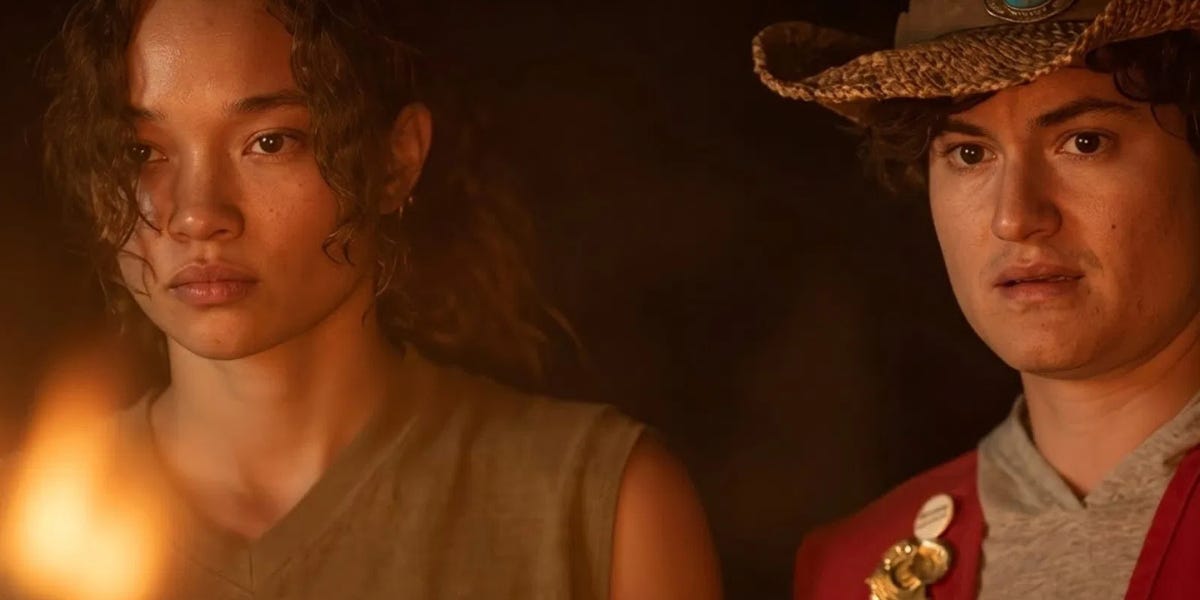
The illusion of a better life
That illusion is what lies at the heart of the film. Hailes herself has described Perfect as a story about chasing the idea of something flawless, about believing that somewhere out there exists a cleaner, safer, better version of life, only to discover that such perfection is itself a fragile construction. You can feel that throughout the film. Kai is not just searching for a new place to live. In Mallory and in the community surrounding the mysterious lake, she sees more than a temporary stop. She sees the possibility of a new beginning, new trust, even a new home. The film quietly but steadily reveals just how thin the line between hope and illusion can be.
Within that setting unfolds a story that is, at its core, actually quite simple, but filmed with such sensitivity to mood, touch, glances, and rhythm that it gradually pulled me in completely. The film’s greatest strength does not lie in what happens, but in how long and how intensely it allows us to remain with its characters. Perfect is a film about outsiders, misfits, and people who do not fully belong anywhere. It carries a strong queer and youthful energy: a naturally breathing world of people trying to build their own version of family and home in a place where the old structures have stopped making sense.

Outsiders, intimacy, and queer longing
That is also one of the areas in which the film feels most convincing. It is clear that Hailes is not simply trying to present a stylized queer story, but to create a space shaped by female and queer experience, especially in the way it understands intimacy. Because of that, the relationships never feel forced or overly schematic. They carry vulnerability, chaos, and a certain strange naturalness.
The film’s greatest asset is, above all, its two central performances. Their relationship feels remarkably natural. Kai (Ashley Moore) is trusting, vulnerable, and emotionally open. In the other woman, she is searching for shelter, but also for proof that it is not too late to begin again. Mallory (Julia Fox), by contrast, feels like someone who knows exactly how much power she has. She is charismatic, confident, attractive, and at the same time slightly manipulative. Not in the sense of a straightforward antagonist, but as someone who can command a space and a relationship through her energy, her calm, and her aura of seeming exceptionality. Kai sees in her the possibility of a better life, while Mallory herself becomes, to a large extent, the embodiment of that dangerous illusion of perfection.
I was also strongly affected by the character of Sunny, who adds another deeply human dimension to the film and fits naturally into its broader line of outsiders, lost souls, and people trying to build something like a community within this strange space. The world of the film ultimately feels made up of people who have lost something, who belong nowhere, and yet have not entirely given up on the possibility of belonging somewhere together.
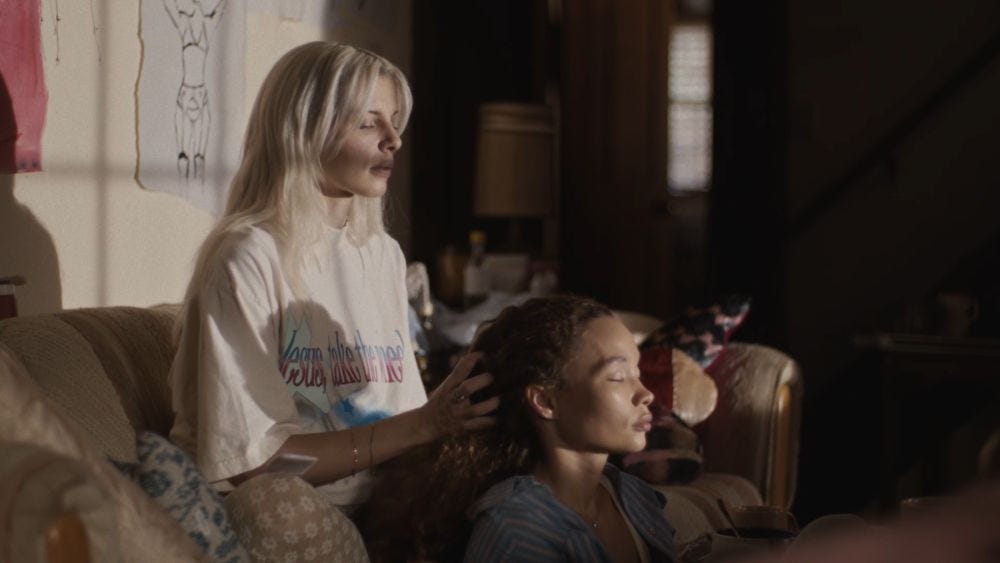
A film carried by mood, music, and chemistry
And then there is the music, which I think is absolutely essential here, a true engine of mood, eroticism, and emotion. In some scenes, the soundtrack becomes almost hypnotic, especially in moments when the characters talk in the car, or when their relationship moves into a more physical and intimate register. The film is sensual, but never cheaply provocative. Its intimacy never feels like a self-conscious attraction in itself, but rather like an organic part of a relationship that is deeply compelling. You can feel that Hailes knows exactly how to work with music, bodies, and pacing in order to create genuine emotional and physical tension.
That is what makes Perfect a film that may not work equally well for everyone. Anyone expecting a fully developed dystopian world or a more intricate narrative structure may come away disappointed. But for me, that was never the point. Perfect works primarily as an atmospheric, intimate, and deeply absorbing film about people desperately trying to believe that somewhere there is still a pure place, a pure relationship, or a pure beginning. And precisely because it captures both the beauty and the danger of that desire, it becomes much stronger than its simple synopsis might suggest.
Millicent Hailes has made a debut that may not be perfect, but all the more capable of leaving a mark. The relative simplicity of the story is not a weakness, because she creates a world I would have gladly stayed in much longer. It is romantic, hypnotic, sensual, a little toxic, a little dreamlike, and above all deeply human. Perfect is ultimately a film about perfection as an illusion, one that it is sometimes far too easy to fall in love with.
Rating: 8/10 ⭐️⭐️⭐️⭐️
Drama / Romance / Erotic
USA 2026
Director: Millicent Hailes
Writer: Millicent Hailes, Kendra A Miller
Cast: Julia Fox, Ashley Moore, Lio Mehiel, Micaela Wittman, Kate Moennig a další
This review is part of my SXSW 2026 coverage from Austin, Texas. You can read more reviews, interviews, and festival coverage from SXSW 2026 in my South By Southwest 2026 section.
Teaser:
Related Articles:
Review: The Ascent (2026) – an inspiring ascent with a darker true-crime echo

The synopsis of The Ascent initially gave me the impression that this would be another powerful inspirational documentary about overcoming life’s limitations. I expected an adventurous and motivational film built primarily around admiration for its protagonist’s extraordinary achievement. But
Review: They Will Kill You (2026) – Sam Raimi Meets Kill Bill in a Satanic Elevator of Death

At the premiere of They Will Kill You, I expected another film in the Ready or Not mold, another bloody chase built around a single character being hunted down at all costs. And I was not the only one. Even before the screening, there were doubts that the film might feel too familiar, maybe even too derivative to be worth seeing in a theater.