
Review: Time Machine Maidan (2026) - A Time Machine into Ukraine’s Memory of Resistance
A hybrid documentary that had its world premiere at Sheffield DocFest, blending archival footage of Maidan, the current war, and personal loss into a formally daring film essay that is not always full

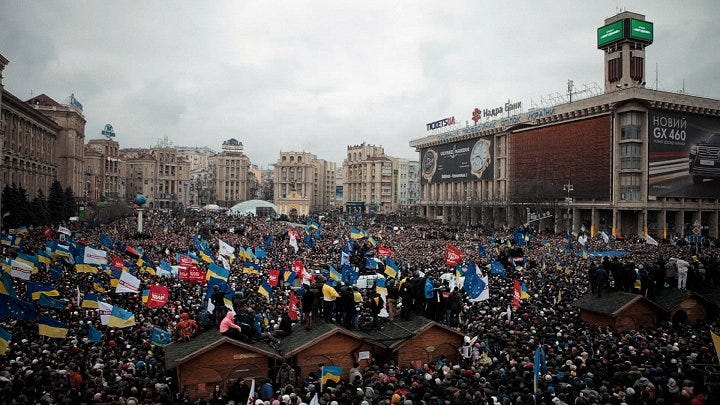
Time Machine Maidan had its world premiere in the International Competition at Sheffield DocFest 2026, where it stood out as one of the more formally daring documentaries in this year’s programme.
The film blends reality and fiction to create a bridge between the bloody confrontations of Ukraine’s Revolution of Dignity in 2013 and the battlefields of today’s Russian invasion of Ukraine. It follows a Ukrainian soldier who is wounded on the front line and, in a liminal state of consciousness, travels back in time to Kyiv in December 2013, directly into the middle of Maidan. There, he tries to find a young poet and future soldier whom he knows will later die in the current war. He wants to warn him and save his life, but gradually faces the painful question of whether history can truly be changed.
Ukraine’s Maidan was one of the defining moments of modern Ukrainian history. It was a collective act of resistance, a rejection of authoritarian power, and a crucial step toward the idea of a freer Ukrainian future. The generation that often watched those events unfold as children or teenagers is now defending the future that Maidan symbolically opened.

A Time Machine Instead of a Conventional Documentary
Rather than a classic historical documentary, Time Machine Maidan is closer to a hybrid documentary essay. It combines real archival footage from Maidan with a fictional time-travel framework, subjective voice-over, and a dreamlike structure. The film is therefore less interested in simply explaining what happened than in exploring how the past keeps returning to the present, and how political history becomes inseparable from personal loss.
The first-person perspective pulled me directly into the crowd, the barricades, the chaos, and the escalating violence. At times, I felt as if I were playing an FPS, or as if I were actually there. The archival material feels raw and authentic. The editing, sound, and music created an atmosphere as if I were not just watching someone else’s history, but entering someone’s fragmented memories.
The filmmakers also make interesting use of the modern digital technique known as “gaussian splatting,” which allows them to reconstruct the space of Maidan from existing footage, turning it into a kind of visual “time machine.” I am curious to see where similar technologies will take documentary filmmaking in the future.
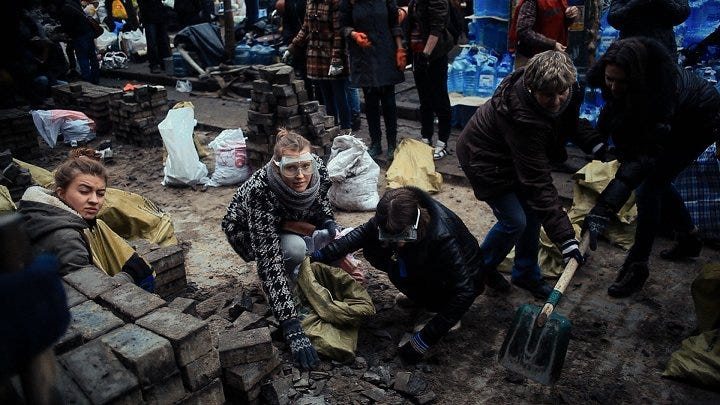
Technology as a Way Back to a Space That No Longer Exists
Time Machine Maidan struck me as a personal and fairly powerful statement. It succeeds in showing Maidan as something still unforgettable, something that continues to shape Ukrainian identity today. Its concept is fascinating, but the structure itself may feel distant for some viewers, at times too abstract and drawn out. The main character often functions more as a symbol of an entire generation than as a protagonist with whom the viewer can form a stronger personal connection.
Anyone expecting a straightforward documentary about Maidan full of historical dates, context, and explanatory information may be surprised by its experimental form and might be better served by a different film. But viewers open to a more dreamlike, subjective, and formally adventurous journey into the past may find a lot to appreciate here. At times, its perspective and physical immersion in historical trauma reminded me of European first-person films that do not simply try to explain history, but rather make the viewer experience it.
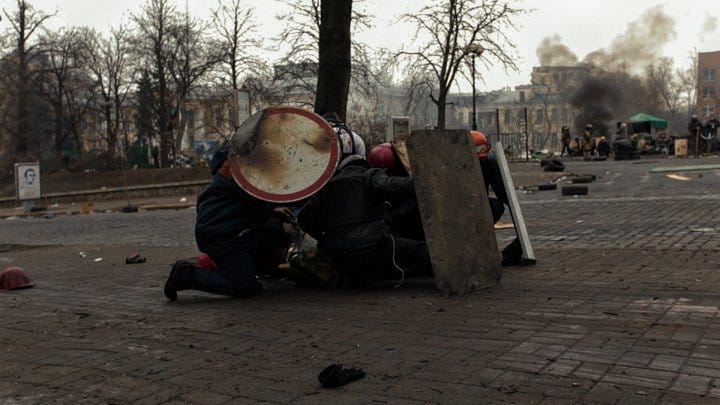
Time Machine Maidan is worth seeing mainly for viewers interested in Ukraine, modern forms of resistance, archival filmmaking, and more experimental documentary form. It is not a completely satisfying film, and its emotional impact remains weaker in places than the subject matter promises. Still, it is a formally ambitious work that presents Maidan as a wound, a memory, and a still-living source of Ukrainian resistance.
Rating: 6/10 ⭐️⭐️⭐️
Documentary
Ukraine / Germany, 2026
Directed by: Roman Liubyi, Volodymyr Tykhyy
Trailer:
soon
Poster:
soon